Participating whole life insurance (often called PAR Life) is easy to misunderstand because it doesn’t fit neatly into the usual boxes of “insurance” or “investment.” In reality, that’s exactly why it can be so useful. PAR Life can function like an asset class of its own: it helps manage risk, supports estate planning, and can deliver long-term, stable growth that’s designed to be less reactive to short-term market and interest-rate swings.
This matters even more in a world where central bank rates move in cycles. We won’t be in a high-interest-rate environment forever. When rates fall, many traditional “safe” options can see yields compress quickly. PAR Life, by contrast, is built to be smooth and stable over time, and recent rate updates have made that stability more visible.
What “PAR Life” Actually is (and why it behaves differently)
A participating whole life policy is permanent life insurance issued by an insurer’s participating account. Policyowners may receive dividends (not guaranteed) based on the performance of that participating account. The key point is that the participating account is typically managed with a long-term focus and a diversified pool of assets, and the policy is structured to build long-term value.
That structure is why PAR Life often behaves differently than many conventional investments. It’s not priced minute-by-minute like public markets, and it isn’t designed to “spike” in good years and “crash” in bad ones. Instead, it’s designed to deliver steadier, more predictable progress over long periods.
PAR Life as Risk Management (not just “a payout if you die”)
Most people think of life insurance as a death benefit, and that’s part of it. But from a planning perspective, the real value is that it transfers a financial risk you can’t time or control.
If someone passes away earlier than expected, the plan doesn’t get derailed. The death benefit can replace income, pay off debts, fund a surviving spouse’s retirement plan, or help maintain a family’s lifestyle. That’s not an “investment return” in the traditional sense, but it is a form of financial risk management that can protect every other part of your balance sheet.
In other words: PAR Life can help keep your plan intact when life doesn’t follow the timeline.
PAR Life as an Estate Planning Tool
PAR Life is also a practical estate planning asset because it can create liquidity at exactly the moment an estate often needs it most.
Depending on the situation, insurance proceeds can help cover taxes, final expenses, and estate settlement costs, or help equalize inheritances (for example, when one child is receiving a business or property). It can also support charitable giving or legacy goals in a clean, intentional way.
The big benefit here is simplicity: it can provide a predictable pool of money at death, which can reduce pressure to sell assets quickly or make rushed decisions.
Long-term Stable Growth: the “boring” advantage
A lot of investors say they want stability until stability looks boring.
PAR Life’s appeal is that it aims for long-term, steady progress rather than short-term excitement. Over time, that smoothness can be an advantage, especially for people who value planning certainty.
When interest rates fall, many yield-focused strategies can feel the impact quickly. But PAR Life is designed to be managed across cycles. That’s why, even with recent rate updates, what stands out isn’t just the headline number, it’s the consistency. PAR Life has delivered relatively smooth, stable performance for many years, including through changing rate environments.
Dividend Scale Announcements for 2026/2027
Each year, major Canadian participating life insurance carriers announce their dividend scale for the upcoming year. These announcements are one of the clearest, most practical signals of how par accounts are navigating changing interest-rate conditions, because they tend to reflect long-term portfolio management rather than short-term market noise.
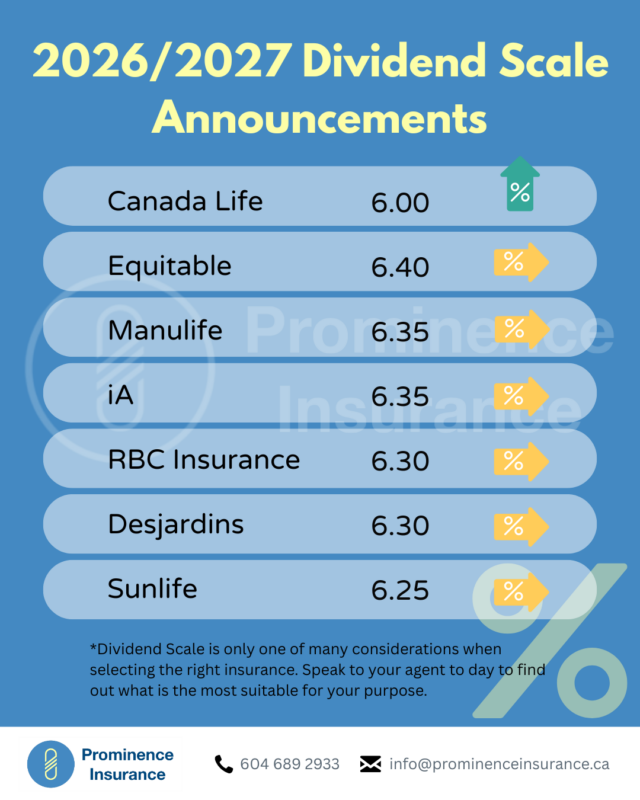
Using the 2026 and 2027 announcement cycle as a reference point, here are the dividend scale interest rates:
- Canada Life: 6.00 Increased
- Equitable: 6.40 Maintained
- Manulife: 6.35 Maintained
- iA: 6.35 Maintained
- RBC Insurance: 6.30 Maintained
- Desjardins: 6.30 Maintained
- Sun Life: 6.25 Maintained
It’s worth emphasizing that dividend scale is only one of many considerations when selecting a participating whole life policy. Product design, funding approach, guarantees, long-term objectives, and how the policy is intended to be used in a broader plan all matter. Still, these annual updates help illustrate the broader point: PAR Life is designed to be managed smoothly across rate cycles, and it can remain comparatively stable even when other “safe” options reprice quickly as central bank rates change.
Why This Matters in a Changing Interest-rate Environment
Central bank policy moves in cycles. High rates can make certain products and strategies look attractive until the cycle turns.
When rates decline, you may see:
- Lower yields on new fixed-income products
- Reduced returns on cash-like options
- Shifts in what “safe” looks like for conservative investors
PAR Life can be a stabilizer in that environment because it’s built for long-term planning, not short-term rate chasing. That doesn’t mean it’s “better than everything else.” It means it can play a unique role alongside other assets.
Who PAR Life is (and isn’t) a Fit For
PAR Life tends to be most useful for people who:
- Want permanent insurance as part of a long-term plan
- Value stability and predictability over short-term upside
- Have estate planning needs (taxes, liquidity, legacy goals)
- Want a conservative, long-term asset that can complement their riskier investments in the market
It may be less suitable if someone needs maximum flexibility in the short term, expects to cancel early, or is still working on foundational priorities like high-interest debt or an emergency fund.
The Bottom Line
PAR Life can be a powerful asset class because it addresses multiple planning needs at once: risk management, estate liquidity, and long-term stable growth. In a world where interest rates and markets move in cycles, that stability is not something to dismiss. It can be the part of your plan that helps everything else work.
If you’re curious whether Par Life makes sense in your situation, the right next step is a simple planning conversation. The goal isn’t to “buy a product.” It’s to understand what you’re trying to protect, what you’re trying to build, and what kind of stability you want in your overall plan.
Contact Us
Contact us for more information or Book your FREE consultation using the form below.
By submitting this form, you are consenting to receive marketing emails from: . You can revoke your consent to receive emails at any time by using the SafeUnsubscribe® link, found at the bottom of every email. Emails are serviced by Constant Contact